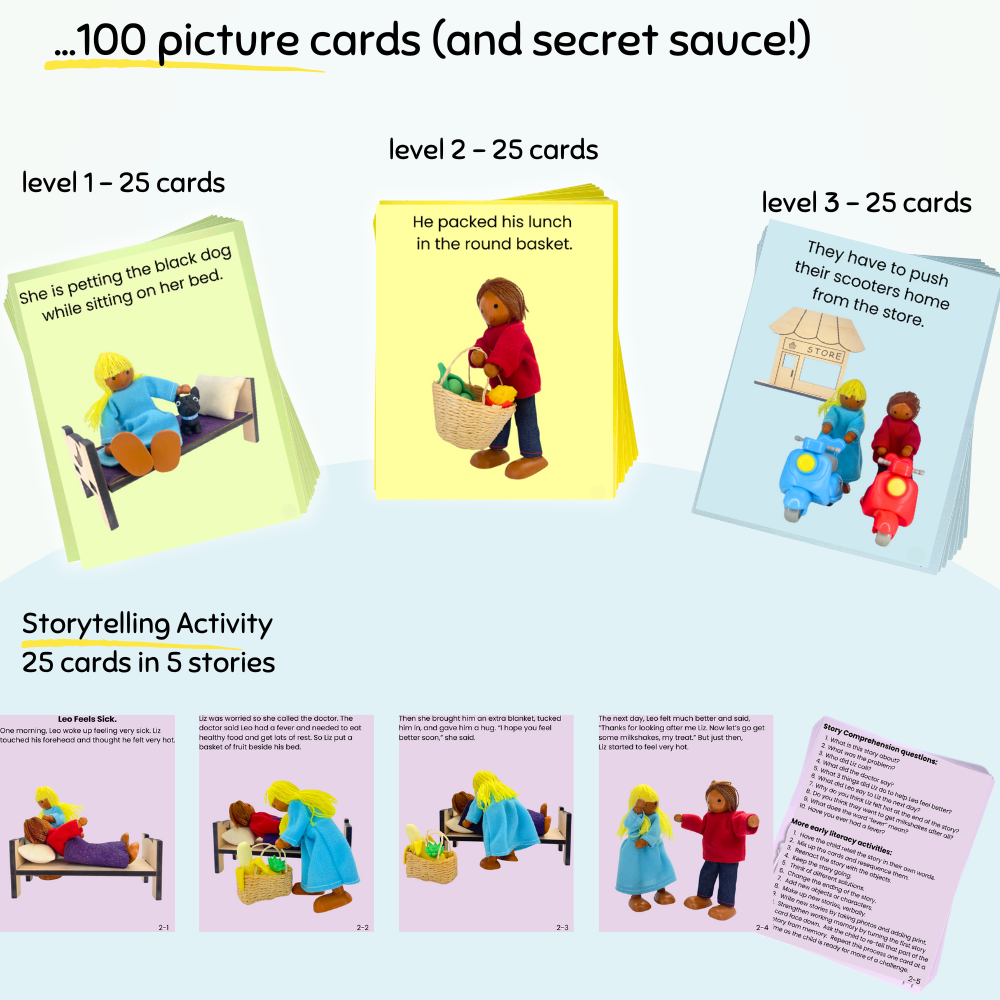

Super Sentences Language Learning Kit
The Super Sentences kit helps children understand and produce complex sentences that contain advanced grammar such as pronouns, conjunctions, verb tenses and embedded clauses. This level of language is common in classroom teaching, stories and everyday conversations.
In addition, the items in this kit were carefully selected to represent familiar settings, such as home, school, and the store to spark pretend play. Children can practice using language that relates to their everyday experiences as they imagine, solve problems, and tell stories.
Use this kit to help children:
- Understand and speak in complex sentences.
- Acquire advanced grammar.
- Comprehend and tell stories.
- Improve working memory and other executive functioning skills.
- Practice social communication.
- Build language through pretend play.
It's easy as 1-2-3:
To work on comprehension/receptive language:
2: The adult arranges the objects as described.
3: The card is revealed and compared to the arrangement. If the child described it accurately, great! If not, provide supports to help them say it better.
Invite pretend play:
Pretend play can enrich children’s language experiences, helping them understand new words and more complex language. As you play together, try using these language-facilitation strategies:
1. Follow the child’s lead.
Talk about what they’re doing, imitate what they say, and add a word or two to expand their sentences. Highlight new vocabulary, and correct grammar by repeating their sentences with the right grammar.
2. Create dialogue between characters.
Practice familiar social exchanges such as greeting people and carrying on a conversation. Highlight how different characters can have different likes, dislikes and perspectives (theory of mind).
3. Introduce a problem to solve.
Help the child explain the problem, think of possible solutions, choose the best one, and discuss how to prevent it from happening again. This is a good example of a verbal reasoning flow.
4. Talk about how characters feel and why.
Help children identify and talk about emotions by naming how a character feels and discussing what could have caused that feeling. Explore what someone might do when feeling sad, mad, anxious, etc.
5. Make up stories and act them out together.
Help children make up stories with key elements such as characters, setting, problems, feelings, sequence of events, and so on. Children need to be able to verbally tell a story before they can write one.


Ages 5-7
Super Sentences